How to check a converted bank statement is complete.
Converters rarely tell you when they drop a row. This is the check that does, by hand in Excel or automatically here.
Drop your statement PDF
Chase, Bank of America, Wells Fargo, TD Bank and other banks (generic reader)
Several months? Select them together: you also get a month-to-month check.
OFX, the QuickBooks CSV and the Xero CSV are for accounting software that imports bank files, and are offered only when the statement balances to the cent. We test-imported the OFX and the QuickBooks CSV into GnuCash (free accounting software): every row, date, sign and the closing balance came out as on the statement. The QuickBooks CSV follows Intuit's published three-column layout (Date, Description, Amount); the Xero CSV has the columns Xero's help page describes (Date, Amount, Description, Cheque number; money out negative; no balances). GnuCash is not QuickBooks or Xero, we have not tried those two, and the Xero CSV has not been imported into Xero by us.
Tested in Microsoft Excel for Windows and Google Sheets (Excel for the web: not tested yet).
One workbook: a Chain proof sheet (live formulas: each month balances, and closing = next opening) and every transaction in one table.
Chase, Bank of America, Wells Fargo and TD Bank: tested on synthetic statements in their layouts and on the sample statements Wells Fargo and TD Bank publish, not yet on customer statements. U.S. Bank and Citi: no official sample exists that we could find, so they use the generic reader. Every file shows whether it balanced. How we test
The rule
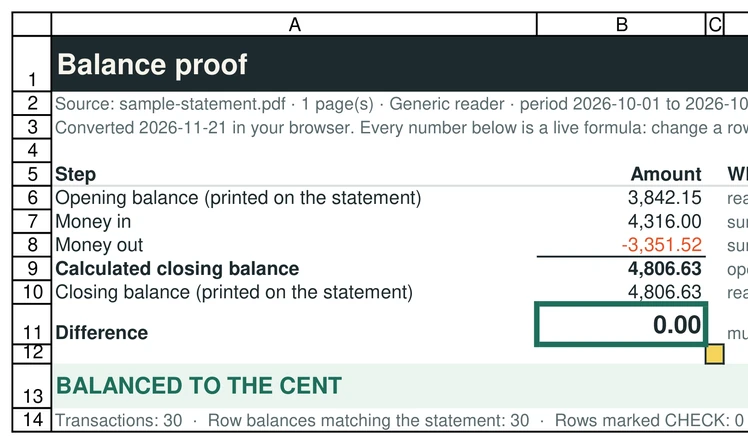
Opening balance + every credit − every debit = closing balance. All three numbers are printed on your statement, so you do not need to trust the converter: you can check its work.
By hand in Excel
Put the opening balance in a cell. Sum the Amount column (credits positive, debits negative).
Add them, and compare with the closing balance on the statement. The difference should be exactly 0.00.
If your bank prints a balance on each row, add a column with the running total and compare it down the page: the first row where they differ is where a line was lost or misread.
Automatically
SheetProof Convert does this on every file and builds the Proof tab with live formulas, so the check is in the spreadsheet you hand to your accountant. Drop a statement above, or try the sample with a row missing to see how a failure looks.
Questions
What if the difference is a few cents?
A digit was misread or a row was split in two. Look at the row the check names and compare it with the PDF.
What if the statement has no closing balance?
Then the check can only compare the rows with each other. The result says so instead of calling it balanced.
Does this prove the transactions are correct?
It proves the rows add up to the printed balances. It cannot catch an error that cancels out, such as two swapped amounts, so skim the descriptions too.